Future students explore bone healing, brain aging at 20th KEYS Showcase
Two summer interns work with biomedical engineering faculty and gain lab experience before their first semester at the University of Arizona.

BASIS Tucson North graduate Jason Jimenez tests a device that binds to bone with mentor Philipp Gutruf, associate department head and associate professor of biomedical engineering.
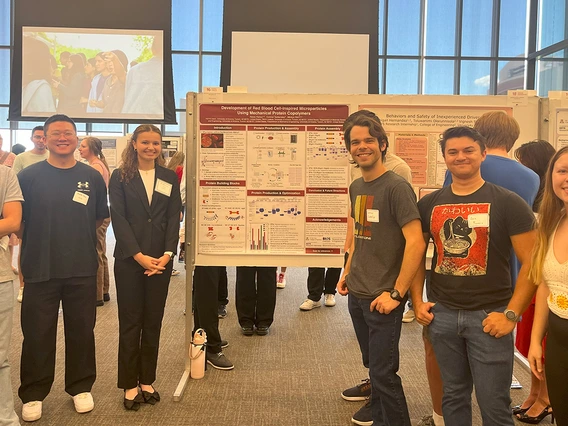
Students admitted to the University of Arizona for the fall shined at the 20th Keep Engaging Youth in Science (KEYS) Internship Showcase on July 17.
The BIO5 Institute’s milestone event marked the culmination of the seven-week summer program, which brought 58 high school students from 36 Arizona schools to the university to conduct research in laboratory settings.
“Programs like KEYS create opportunities for talented students to discover their interests, build confidence and see themselves as future innovators,” said Philipp Gutruf, associate department head of biomedical engineering and KEYS mentor. “I have seen firsthand how transformative early research experiences can be.”
Gutruf and BME associate professor Elizabeth Hutchinson mentored two KEYS interns on research projects that improved bone fracture monitoring and explored how brain aging affects ferret hunting behaviors.
Pushing the limits on bone implants
BASIS Tucson North graduate Jason Jimenez worked in Gutruf’s lab to improve the reliability of an implantable osseosurface device – a tiny, wireless and battery-free sensor system placed directly onto living bone that could reduce the need for frequent X-rays and clinical checks.
“When you have a bone fracture, you have to get monitored and get X-rays constantly,” Jimenez said. “The osseosurface device has the potential to eliminate that.”
Before the device can be used clinically, researchers in Gutruf’s lab must ensure it can withstand the repeated movement and mechanical stress it would experience inside the body.
To study the device’s durability, Jimenez created a replica of a rodent’s hind limb to simulate the conditions of small-animal testing. He 3D-printed a skeletal frame and attached silicone components to mimic skin and muscle.
His testing system used a motor to repeatedly move the replica femur back and forth, mimicking the continuous motion a device would experience in a moving rodent and allowing him to compare how different serpentine structures held up under mechanical stress.
“Jason’s project supported our work on osseosurface electronics, an emerging class of implantable systems that integrate with bone to create stable long-term interfaces with the body,” said Gutruf, the College of Engineering’s 2024 da Vinci Fellow.
The device operated for more than 100,000 cycles before failure on its first run. In the second round, it lasted more than 260,000 cycles.
“As the testing gets longer, the resistance increases,” Jimenez said. “That helps us understand when the device will break.”

Joshika Singh (left) works with biomedical engineering associate professor Elizabeth Hutchinson to identify how aging affects ferrets' behavior.
Using AI to analyze animal behavior
Joshika Singh, from Arizona College Preparatory High School, worked in Hutchinson’s lab to build on previous findings that aging ferret brains shrink in regions responsible for sensory processing. Singh investigated if older ferrets became worse hunters.
She programmed a robotic ball to simulate prey movement and then recorded the animals' responses. Using DeepLabCut, a machine learning-based motion tracking program, Singh analyzed thousands of video frames to compare the hunting behavior of young and old ferrets.
"We found that the older ferrets did interact with the ball less," Singh said. "This provides valuable information for future ferret Alzheimer's models”
Singh said learning skills like coding helped build her confidence, a transformation Hutchinson also witnessed.
“Joshika came in with a strong interest in veterinary sciences and a strong skill set in math and engineering and was able to merge those into a fun and productive project,” Hutchinson said. “I was glad she chose the Sphero Ball to work with since it is a good demonstration of how we can leverage technology like robotics and machine learning to explore fundamental behavioral outcomes.”
While Singh had plans to pursue a career as a veterinarian, she is now considering adding biomedical engineering to her undergraduate studies.
"I learned that I can do hard things," she said. "I was finding errors in my data and really struggling at times, but I persevered."