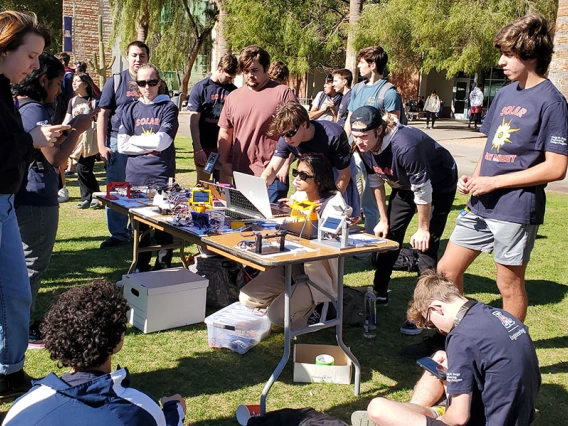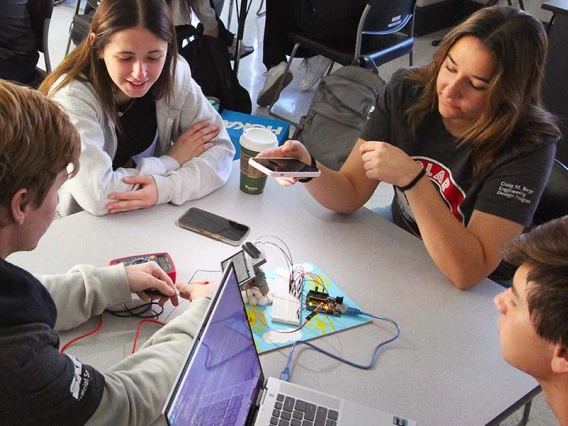
First-year students dive headfirst into design at Solar Track Meet
The annual event prepares undergraduates for success with experiential learning.
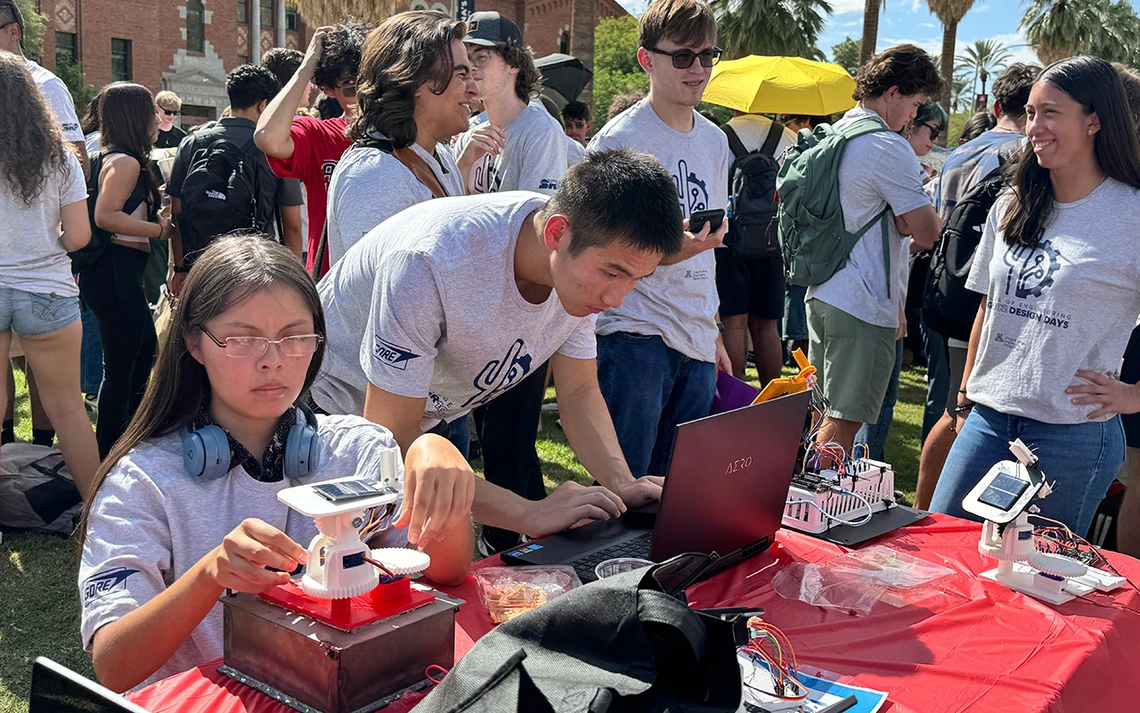
At the October 2025 Solar Track Meet, first-year students present their team-designed autonomous solar trackers for peer judging.
Students across the college begin turning theory into action early on, starting with two Engineering 102B projects.
First-year students in the required course design and build autonomous trackers that follow the sun’s movements and measure solar energy. Then they peer judge one another’s projects at the annual Solar Track Meet. The second project, presented at Engineering Discovery Day in November, is a topic of their choice.
“I cannot wait to explore more design projects,” said Derek Cadiz, a mechanical engineering major, who was among 560 participants gathered in teams of three or four at the University of Arizona Mall on Oct. 21 to present their trackers.
The college established the Solar Track Meet in 2022 with support from ongoing sponsor the Salt River Project utility company. In 2025, the event transitioned to the inaugural project for the four-year Craig M. Berge Engineering Design Program, which culminates with Design Day, where seniors showcase their year-long industry-sponsored projects.
“This event is the first step in understanding what engineering is really about,” said Elizabeth Hutchinson, assistant professor of biomedical engineering and ENGR 102 instructor.
Going the extra mile
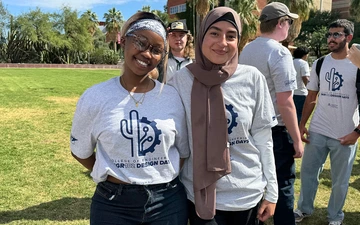
Kago Mathabatha (left), chemical engineering and electrical and computer engineering undergrad, works with teammate Nora Elnady to create a custom solar tracker base modeled after the PIXAR toy lamp.
Some students went beyond those first steps and project requirements. Kago Mathabatha’s team integrated a 3D-printed, solar-tracker-powered custom lamp.
“This project was challenging because we had to learn code we’d never seen before and how to use a 3D printer,” said the chemical engineering major minoring in electrical and computer engineering. “It was all completely new to us, but it was rewarding to bring our design to life.”
Students first became certified in 3D printing to build at least one 3D-printed part. They programmed microprocessors, learned to store solar power and wired electronic microcontrollers.
“In the end, they wind up with this device that not only tracks the sun but can tell how much power is coming from the sun,” said Joanne Robertson, adjunct lecturer and ENGR 102 instructor.
Award winners
Among cash prizes rewarding teams for overall performance and best physical design, coding and design explanation were the SRP Innovation, Dean’s and Instructor’s Choice awards.
Solar Track Meet team Megawatters won the SRP Innovation Award. Team members included:
• Willy Paz Pacheco
• Paolo Leatham
• Graham Van Der Beek
• Tristan Kordell
The Dean’s Choice Best Engineering Design Award went to team Glitter Sparkle. Students on the team included:
• Jeremiah Kristanto
• Auston Mezzanotte Morrison
• Sonny Necoechea
• Sabian Rodriguez
Team 10 won the Dean’s Choice, Most Creative Design Award. Team members included:
• Jaden Creary
• Marshall Lasater
• Mason Lusche
• Nguyen Hoang